

The exhibitor manual is the least-read document in the exhibition industry and the one that decides most of what you can actually do with your stand. It arrives as a PDF, often fifty pages or more, usually at the point when the show still feels a long way off.
Then it gets opened a fortnight before build-up, when the artwork is already printed.
Almost every expensive problem on a shell scheme booth traces back to something that was in the manual all along. This is what to pull out of it, and when.
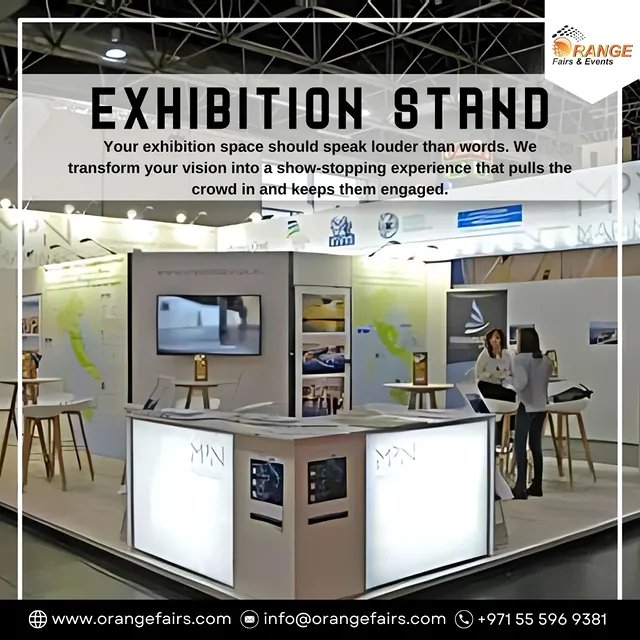
[IMAGE 1 — alt: “Exhibitor manual open beside a shell scheme booth layout, Dubai exhibition”]
What an exhibitor manual actually is
An exhibitor manual goes by several names — technical manual, exhibitor services guide — and it is issued by the organiser once your space is confirmed. It is the contract for what you may build, who may build it, and when.
It matters because shell scheme packages are not standardised. Across published manuals the variation is wide: one show includes grey carpet, a single 500W socket and three spotlights on a track; another includes a table, two chairs and a bin per 9 sqm; another includes stand lighting but charges separately for any power that runs an exhibit. A description you read on a contractor’s website, including ours, is a general pattern. Your manual is the specific answer.
The four dates that govern everything
Find these first. In most exhibitor manuals they are rarely on one page, and they are almost never the dates you expect.
- Artwork and print deadline. The real deadline on most shell scheme jobs. Everything upstream compresses to meet it.
- Services order deadline. Electrical, furniture, additional lighting, stand cleaning. These close well before build-up, and ordering late usually attracts a surcharge — one published manual applies a 25% increase after a stated cut-off.
- Build-up access window. The specific hours your contractor can be in the hall, which is not the same as the day before the show.
- Breakdown window. Dismantling of shell scheme stands can begin immediately at closing. Anything you have not removed may not survive it.
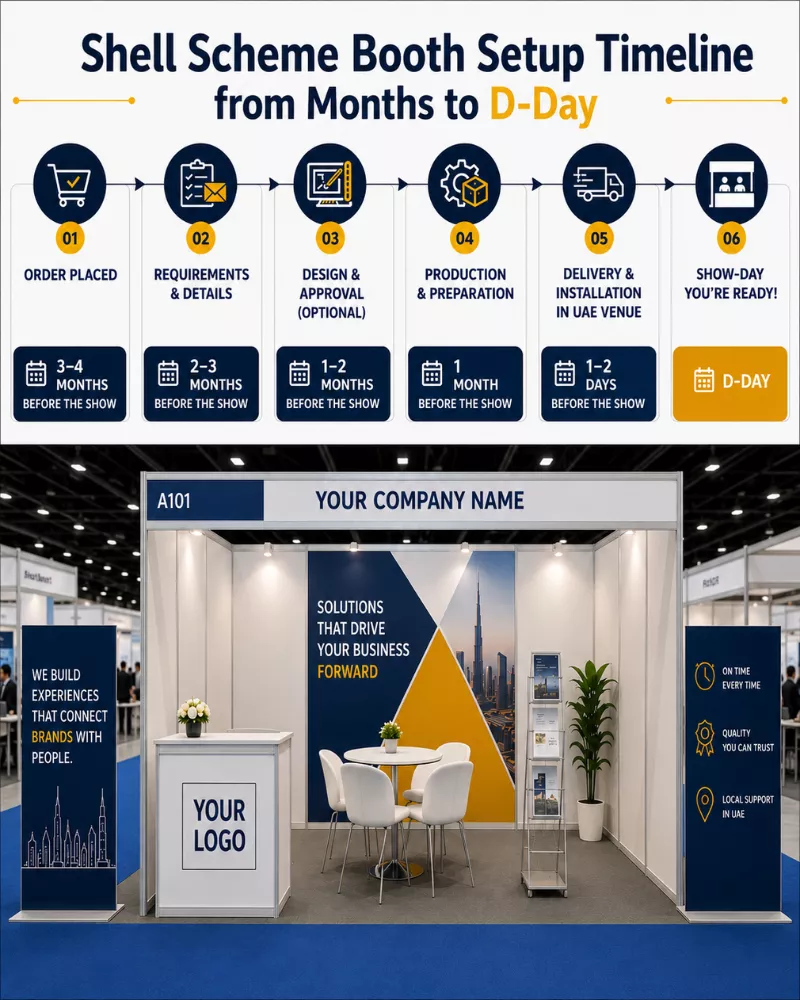
Venues publish their own technical guidance alongside the organiser’s manual — Dubai World Trade Centre and Dubai Exhibition Centre both do, and the two sets of rules are not the same. Put all four dates in your own calendar, working backwards. Our exhibition booth setup timeline covers how the full sequence fits together once you have them.
The dimensions to extract, and why they are not what you assume
Square metres are the number everyone quotes. They are rarely the number that constrains the design.
Internal height
Shell scheme internal height is commonly around 2.5 metres from floor to the underside of the ceiling grid, and nothing may be erected above it inside the booth. Exhibitor manuals state this explicitly because it is so often missed. A graphic designed to a wall height that does not exist has to be reprinted.
Panel dimensions, not wall dimensions
Your back wall is several separate panels, each with its own usable print area once the frame is accounted for. Design to the panel sizes given in the exhibitor manual rather than to the overall wall width. This is the single most common cause of artwork that arrives trimmed in the wrong places.
Fascia character limit
The name board carries a character limit and a fixed typeface, both set by the organiser. Published manuals vary — one specifies a maximum of 24 characters including spaces, another specifies 12 cm blue capitals on white laminated board. Check yours before deciding what goes on it, because a trading name that does not fit will be truncated by the contractor, not by you.
Stand number and open sides
The floor plan tells you how many sides face an aisle. A corner booth and an inline booth of identical area are different design problems. Send your stand number to your contractor along with the size — it tells them more than the dimensions do. More on that in our guide to shell scheme booth design.
[IMAGE 2 — alt: “Shell scheme fascia name board at a Dubai exhibition”]
The fixing rules — where stands get rejected
This is the section that causes the most damage when it is skipped, because it is discovered on build day with no time left.
Shell scheme walls belong to the organiser’s contractor, not to you. Published manuals are consistently blunt about it: nailing, screwing, stapling, drilling, painting and wallpapering the panels are commonly prohibited outright, with damage charged back to the exhibitor. Some manuals also prohibit any alteration to the exterior of the structure or to the fascia, while allowing complete freedom inside the booth provided nothing projects into the aisle or onto a neighbouring stand.
What that means in practice:
- Confirm the permitted fixing method before artwork goes to print, not after. The method determines how the graphics are produced.
- Check whether fascia modification is allowed at all. At some shows a branded fascia panel is straightforward; at others the name board cannot be touched.
- Check what must be removed at breakdown. Several manuals require all tape and Velcro to be stripped from the walls before you leave.
- If you intend to hang anything heavy, find the clause covering it and speak to the organiser’s operations contact first.
The approved contractor list
Most exhibitor manuals carry a list of official contractors, and one is usually explicit about what that means: if a company is not listed in this manual, they are not an official contractor.
Read that carefully, because it does not usually mean what exhibitors think. The official shell scheme contractor owns the structure and supplies the structural extras. For branding, graphics, furniture and fit-out inside your own booth, you are generally free to appoint your own supplier, subject to the manual’s rules and to that supplier holding a valid trade licence and the right venue passes.
Where it does bite is venue accreditation for anything structural. And it is worth noting that accreditation is venue-specific, not city-specific — Dubai World Trade Centre and Dubai Exhibition Centre at Expo City operate separate technical departments and separate approved contractor lists. A build team cleared at one is not automatically cleared at the other.
Power, and the thing people get wrong
Shell scheme packages typically include a small lighting allocation and often a single socket. Published manuals frequently distinguish between power supplied for stand lighting and power for the live operation of exhibits — the second is almost always ordered and charged separately.
So before the services deadline, add up what actually plugs in: screens, demonstration equipment, a kettle, laptop chargers, any integrated lighting in a counter. Then order once. Ordering late costs more, and ordering on site costs more again.
Your exhibitor manual checklist: 12 things to extract
Open the exhibitor manual and extract these twelve items onto a single page:
- Stand number, dimensions, and how many sides are open
- Internal height limit
- Individual panel dimensions
- Fascia character limit and whether it can be modified
- What the package includes — carpet, lighting, sockets, furniture
- Permitted fixing method for graphics
- Artwork deadline
- Services and electrical order deadline
- Build-up access window
- Breakdown window and removal obligations
- Approved contractor list and what it covers
- Freight forwarder, delivery address and storage arrangements
Twelve lines. Send that to whoever is building your stand and most of the back-and-forth disappears.
[IMAGE 3 — alt: “Branded shell scheme booth installed at a UAE exhibition”]
Frequently asked questions
What is an exhibitor manual?
An exhibitor manual is the technical document the organiser issues once your space is confirmed. It sets out what you may build, who may build it, what the package includes and the deadlines that apply. It is sometimes called the technical manual or exhibitor services guide.
Is every shell scheme package the same?
No, and this is the most common misunderstanding. Inclusions vary by exhibition and sometimes between halls at the same venue. Carpet colour, lighting allocation, socket count and whether any furniture is included all differ. Work from your own manual.
Can I drill or nail into shell scheme walls?
Generally no. Published manuals commonly prohibit nailing, screwing, stapling, drilling, painting and wallpapering, with any damage charged back to the exhibitor. The permitted fixing method is stated in the manual and should be confirmed before graphics are produced.
Can I change the fascia name board?
It depends on the show. Some organisers permit a branded fascia panel; others prohibit any alteration to the fascia or the exterior of the structure. The manual states which, and there is usually a deadline for requesting fascia removal.
Do I have to use the official contractor?
For the shell scheme structure itself and structural extras, usually yes. For branding, graphics, furniture and fit-out inside your booth you can generally appoint your own supplier, subject to the manual’s rules and the supplier holding the right licence and venue passes.
What happens if I miss the services order deadline?
Late orders typically attract a surcharge, and some shows apply a stated percentage increase after a cut-off date. On-site ordering, where it is possible at all, costs more again.
When should I read the manual?
As soon as it arrives. In every exhibitor manual the artwork and services deadlines sit much earlier than exhibitors expect, and both are usually weeks before build-up.
If you would rather not read the exhibitor manual yourself
We read the exhibitor manual for your show as part of quoting every shell scheme job — dimensions, fixing rules, fascia specification, power allocation and the four deadlines — so the design is built to your show’s rules from the first draft rather than corrected later.
Send us your exhibition, stand number and size and we will come back with a 3D concept and an itemised quote. The design costs nothing.